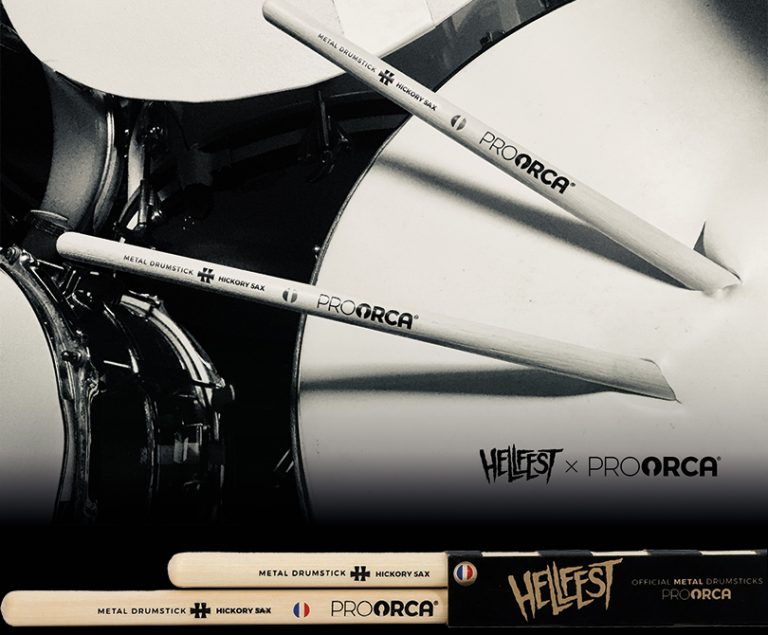
Designed in partnership with the Hellfest, the number one metal festival, Pro Orca launches the “Hellfest Official Metal Drumstick.”
Made in France with premium grade American Hickory, the drumstick is slightly longer to provide a bigger sound.
The French flag on the sticks is an embossed hallmark. It serves as an inlay to place your thumb or your forefinger to find the perfect ‘balance point’ of the stick.
100% American Hickory (premium grade)
Wood tip
Size 5AX
Length 16.6” / 419mm
Diameter 0.580” / 14.8mm
Packaging Made In France with 100% recycled cardboard.
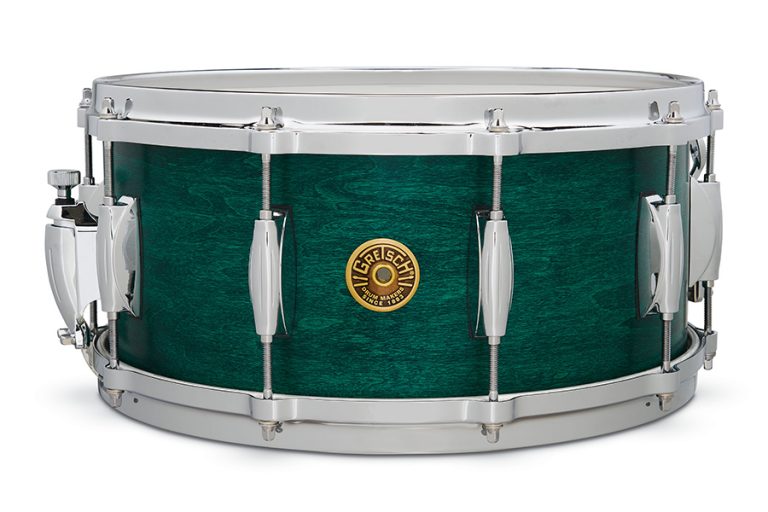
Gretsch Drums proudly introduces the USA Custom Ridgeland Snare drum to their celebrated range of snare of drums. At almost half-inch thick and made from a fusion of woods, this new drum has a sound that is warm, powerful and loud!
For nearly 40 years, Gretsch Drums have been hand-crafted in Ridgeland, South Carolina using the finest materials available. It’s here that a team of dedicated artisans consider every detail to ensure that each drum possesses “That Great Gretsch Sound.” The USA Custom Ridgeland Snare Drum has been developed in the time-honored tradition of Gretsch drums to showcase the dedication and passion of these artisans.
The 0.4” shell, made of maple, gum and poplar, features a hybrid bearing edge that combines the classic Gretsch 30 edge with an old-school Broadkaster-style roundover; the result is a warm, full-bodied tone with plenty of attack. These new snare drums are equipped with sturdy 4mm die-cast counter hoops, the ever-popular Lightning Throw-Off, 20-strand snare wires and Gretsch Permatone drumheads. Custom made, the Ridgeland Snare Drums are available in 5×14 and 6.5×14 sizes and in all Gretsch Nitron, Satin or Gloss Lacquer finishes to perfectly match any drum set.
The Ridgeland, born in the South, made to inspire. For a preview of the Ridgeland snare drum, watch the video below.
For more information about the USA Custom Ridgeland Snare Drum, other Gretsch drums and artists, please go to gretschdrums.com/
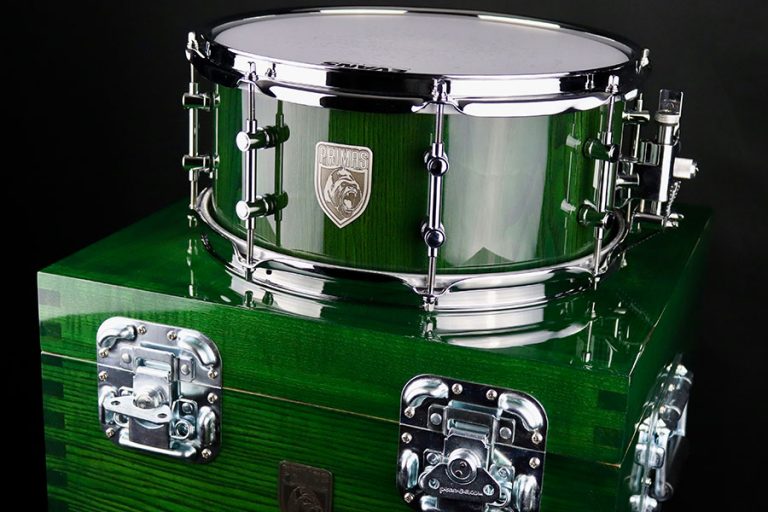
UK-based custom drum company Primas Custom Drums is the brainchild of Eddie Hodgkinson, who is determined to make an impact in the world of custom-designed and manufactured drum kits. Following the Drummer’s Review team’s recent look at a quartet of Primas Snares, as well a successful exhibition of his designs at The UK Drum Show, Eddie is keen to share the message about his unique concepts of design and manufacture. Drummers Review’s Andy Hughes got the details…
Tell me about the start of Primas Custom Drums, I understand you simply decided one day to make a drum.
I have been playing drums for more than twenty years in a variety of bands and projects. This experience teamed with a background in mechanical engineering, wood working, and a natural curiosity for how things are made, progressed into producing my first drum back in 2015.
It was always a craft I wanted to be involved in and I had so many ideas. Since then, many hours of work, experimentation and testing has enabled me to produce some beautiful work. I am now in the position where I am ready to share my creations with the world and give drummers the opportunity to own some of the highest quality drums available, steering away from mass produced ply drum shells. I wanted our brand to represent the nature of the drums; solid, powerful and projecting.
It’s interesting that you have a background as a musician, and also as an engineer, was that combination the motive to start manufacturing drums?
Yes, very much so. As a drummer, I was always looking for new sounds and as an engineer, the different processes, wood types and methods to produce a variety of sounds really sparked my interest.
The development of processes and the technicalities of accurately transforming a flat board into a drum sounded like a fantastic and exciting challenge to me.
What particularly attracted you to stave and segmented shells?
As a drummer, I always knew what sound I was looking for – I wanted a focused and projecting sound with a solid attack. That lead me to investigate different drum shell building methods and their attributes, searching for that ‘holy grail’ for my own personal tastes. This is how I discovered stave and segmented drum building methods. These methods also aroused the interest from the ‘engineer’ side of me.
The process of taking a flat board and creating a cylindrical drum that is accurate, and under minimal stress and strain, and that produces a projecting and focused sound was the start of my obsession with building drums.
How difficult was it to work out the manufacturing process?
Luckily for me, I have a lot of background knowledge that has helped me to develop my production processes. The process of milling and machining the drum shells has been a big focus for me. As an engineer, but also as a drummer, the concentricity and circularity accuracy of every drum shell is of high importance. This affects the tuning of the drum and the overall quality.
Have you had to design and build specialist equipment to produce your drums?
Yes. Among other tooling, I have spent a considerable amount of time designing, testing and building my own machine to mill shells to achieve the finest tolerances within a cost effective and timely manner.
For those who don’t know, can you describe the difference in a ‘stave’ shell from a standard shell?
The majority of wooden drum shells are plywood, mainly due to the ease of mass production. Plywood shells are very thin slices of wood veneer formed and glued together to form a shell. Stave drums are vertical pieces of solid wood that are cut with angles, glued together like a barrel and then machined round to form the shell.
The biggest differences between the two shells are the amount of glue, the orientation of the grain and resulting sound – more tone wood delivers more tone.
Stave drums only use a fraction of the glue that is used in ply shells, resulting in a much more focused sound and that enhances the fundamental tone of the woods used, much more dramatically.
And a ‘segmented’ shell?
Segmented shells are constructed in a very similar way to stave drums except the grain is orientated horizontally and the shell is made up of numerous layers. A great method for bringing the advantages of different tone woods together to produce unique sounding, and looking drums.
Does your specialisation limit the potential customer base that other manufacturers who provide wider specs may enjoy?
In terms of wooden shells, most larger companies only offer mass produced ply shells. With Primas, I provide an opportunity to possess higher quality and superior alternatives to abundantly mass-produced drums. I feel there is a lack of knowledge about these methods that makes it harder to compete with the bigger companies, because the market is saturated with ply drums, and this is the go-to for a lot of drummers who haven’t experienced what stave and segmented drums can offer.
In terms of specs, Primas can offer a lot more scope for customised and personalised options than most larger companies, and at the higher end of the market, our drums perform very competitively in comparison.
Check out our recent review of a quartet of Primas Custom Drums Snares..
From a player’s perspective, what are the advantages of using stave or segmented shells over and above standard kit design and manufacture?
Stave drums offer a projecting and focused tone with a short sharp attack and a short sustain that ply shells cannot compete with. As for segmented shells, they offer a dampened and slightly more subtle attack than their stave counterparts, with unlimited configurations.
Both stave and segmented shells offer tonal qualities superior to that of ply shells and the fundamental tonal differences between the different tone woods are a lot more apparent with these types of construction, resulting in a wider range of options.
Due to the nature of the construction, stave and segmented shells are more stable and, in my view, they are a lot more accurate in their sound responses. Stave and segmented drums are shaped to product the shell, rather than forced into an unnatural position, meaning the stave and segmented shells, to a degree, remain in their natural state so don’t have the same tendencies to move like ply or steam-bent shells.
Are your stave and segmented shells as durable as standard designs?
All Primas shells are made to the highest standards, using the best quality materials and methods to ensure their structural integrity. Under normal playing, transport and storage conditions, stave and segmented shells are equally as durable as ply shells. The only circumstance that they are more likely to be damaged is if they take a heavy, direct impact to the shell wall itself.
Both stave and segmented shells are predominately solid wood, which isn’t as strong as glue, making them slightly more vulnerable to impact damage, but under normal circumstances they will last just as long as standard design shells.
What sort of woods do you usually use for your drums?
The Primas stock models are The Sliverback Series, The Bononbo Series and The Barbary Series. They utilise the interesting tones created by Padauk, Black Walnut and Mahogany. These tone woods have been specially selected for their individual characteristics, and to give drummers different options across the tonal spectrum.
From The Custom Shop; many options are available. Including; Maple, Beech, Purple Heart, Zebrano, Wenge, Ash, Sycamore and many more.
The pandemic has seen a seismic change for players, and suppliers of drums – how did it affect your business?
As a fairly new business, it has actually been quite useful to have some extra time to experiment, build stock and focus on other parts of the business. That said, it is nice to see things heading back to some sort of normality and I hope to have more opportunities to showcase what Primas can do and reach a wider audience.
Now that we are thankfully approaching the end of the worst of the pandemic restrictions, how are you moving the company forward to catch up on lost time?
It’s great to see the return of exhibitions such as The UK Drum Show and other events. It was fantastic to showcase Primas at The UK Drum Show earlier this year, we had a fantastic response and look forward to exhibiting again next year! Plans for this year include the filming of some insight/demonstration videos to showcase our products and talk through videos with Primas artists. There are also some new models currently in the pipeline that will be released throughout the year and sent out to reviewers. With things returning to normal, Primas has been able to recently secure our first U.K retailer – Drumazon in Cardiff. It’s a real honour to have Primas Drums in a drum store that is well known for high end drums in the U.K.
Do you have a foothold in international markets?
I’m proud to say Primas drums are finding their way around the world, with orders going to the USA, Europe, Asia and even as far as Australia. In terms of stockists, Primas can be found in Drumazon in Cardiff and we are now looking at securing stockists in the USA, Europe and Australia.
Is there a particular genre of music that is more suited to your design of drums, or will they work in any style and format?
As our stock models have a wide selection in terms of tone woods and other specs, with considerable options available for custom shop models, Primas drums can be tailored to suit a variety of styles and genres.
Is there one player out there you feel able to name, who would be your dream client?
Wow such a hard question! There are so many great drummers out there. I’m always drawn to powerful and skilful drummers, such as Thomas Pridgen, Eric Moore, Benny Greb, Thomas Lang, just to name a few. It would be a real dream to work with any of these guys!
Do you have plans to expand your current operational set-up in the future?
The current setup is great, but as the business grows, so will the need to expand the work space to enable more drums to be ‘works in progress’ as we look to expand our designs, but the current setup is more than adequate for now.
What’s next for yourself and the company?
Current plans for the company include securing more retailers across the UK, USA and Europe, adding new drummers to the list of current endorsing artists and the addition of new models to the current line-up of Primas drums. On personal level, I hope to get some more time behind the kit! Since my band stopped playing together when COVID hit, I’ve not really played much, I’m too busy. But I am planning to make time for playing, as a drummer first and foremost, I will never stop playing.
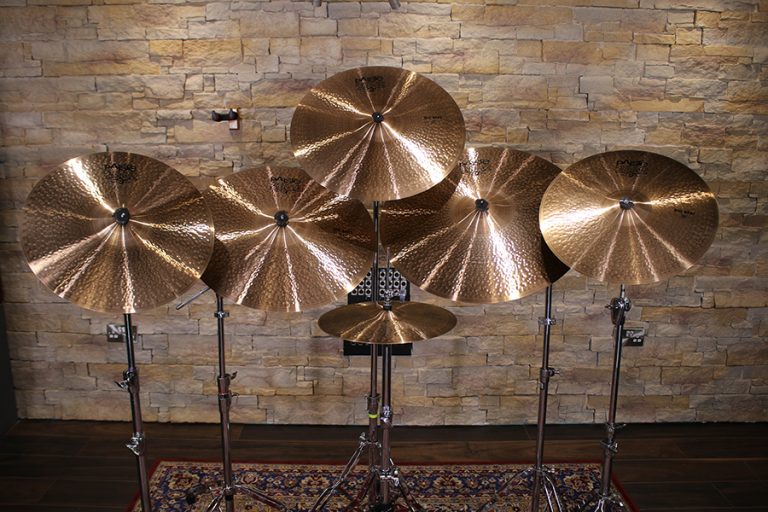
Here’s our review of a selection of Paiste 2002 Big Beat cymbals, featuring…
15″ Hats,
18″ Crash/Ride
19″ Crash/Ride,
20″ Crash/Ride,
21″ Crash/Ride,
22″ Crash/Ride,
24″ Crash/Ride,
Constructed from Paiste 2002 bronze alloy,
Matte finish with black 2002 logo.
Paiste Says…“2002 Big Beat represent a modernized, yet timeless interpretation of the legendary 2002 sound. Visually, the cymbals feature a distinctly new hammering pattern for the 2002 family, a slightly darkened, semi-matted finish and simplified black logos to distinguish the Big Beat set. With the 2002 Big Beat models, we take the 2002 sound into a new realm, while preserving the legendary 2002 heritage.”
Be sure to check out our review of Paiste’s original 2002 range of cymbals…
————
For more completely impartial, HD video reviews, please subscribe to our YouTube Channel: www.youtube.com/drummersreview and click on the bell icon to be notified as soon as each new video is released. You can also follow us on our social media channels:
All of Drummer’s Review videos are recorded in a top quality studio with the finest equipment. To get the best from our reviews and really hear the instruments perform be sure to listen on good quality speakers or headphones!
The UK Drum Show which returned at the ACC Liverpool earlier this year, is set to expand for 2023 with key Educational features and “How To” experiences following a polling of their 2022 guests.
The UK Drum Show which took place on the 2 & 3 April for its fourth year, but for the first time at the larger venue, the ACC Liverpool, saw its largest gathering with over 5000 tickets sold for this two day dedicated consumer drum and percussion exhibition.
Left to right: Louie Palmer, Richard Spaven, Greyson Nekrutman confirmed for The UK Drum Show 2023
In addition to largest gathering of drum and percussion products, main stage artists and clinics, with Louie Palmer, Richard Spaven and Greyson Nekrutman already confirmed for 2023, with further acts to be announced, organisers Gold Media & Events is set to announce further content to attract drummers far and wide.
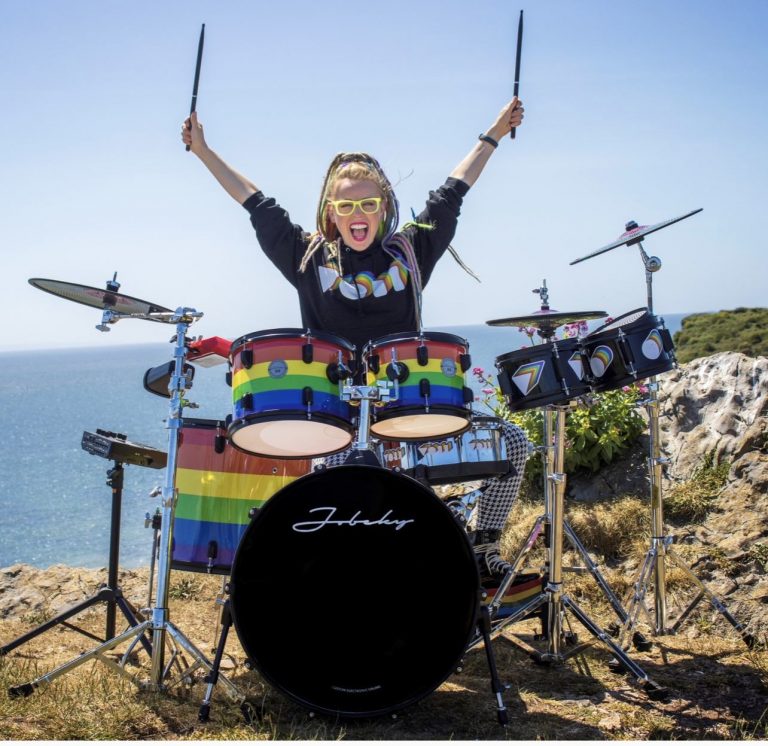
With several announcements to follow, “How To Hybrid” in association with Jobeky Drums and featuring Vicky O’Neon kicks off the first announcement of additional content guests will experience at The UK Drum Show 2023.
“Jobeky are pleased to present “How to Hybrid” at the UK Drum Show 2023″.
“Jobeky have been making electronic drums, cymbals and triggers for 17 years and will talk about and show how you can incorporate electronics into your playing, whether that be using a few electronic drums in your setup or a full electronic kit or even drop in triggers to turn your kit into an electronic kit”.
The triggers Jobeky make can even be used under an acoustic kit for live playing to trigger samples. Electronics are being used more and more by drummers now whether for home use or live and Jobeky can show you how easy it is to incorporate them into your playing.
Vicky O’Neon will join Jobeky drums to demonstrate how to incorporate triggers and electronic drums to your live set up. Together they will break down the technical aspects of triggering and also show the great advantages with hybrid and electronic drums to recreate advanced electronic drum productions live, something that is becoming more and more important for drummers today!
After spending years in the planning stages, plus a COVID-19 pandemic delay, the Percussive Arts Society finally brought to life the long-awaited PAS Drum Set Competition. Throughout the competition, which spanned June 15-16, three rounds of international contestants showed off their musicality, creativity and finesse behind the drums for a celebrity panel including Sonor artist Aaron Spears. The contestants progressed to the final performance under the glass dome of the Indianapolis Artsgarden in Indianapolis, IN.
Sonor Brand Manager Jeff Mulvihill recalls, “The spirit of camaraderie threaded throughout this event. Although it was a contest with a winner, it was also a great display of drummers getting together to talk, hang out, tune, tell stories, play, practice and learn more about drums and drumming.“ The finalists performed for an enthusiastic live audience as well as a world-wide online audience via livestream presenting solo, recorded track and live band segments. For more information and a complete review of the finalists and the winner please visit https://www.pas.org/drumsetfinals.
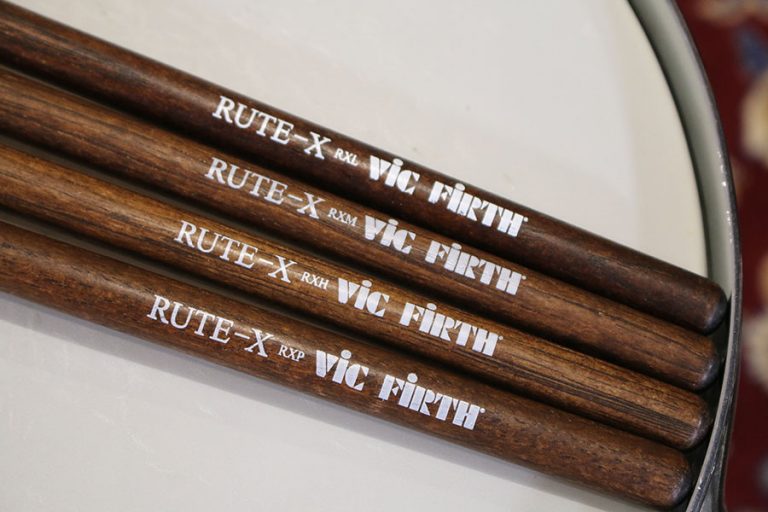
Over the years there has been a definite swing towards more acoustic live acts in venues. This meant that drummers had to adapt from full kits to mini kits, possibly changing to hand percussion and cajons etc.. One of the easiest ways to quieten the sound was always by changing from sticks to either brushes or multi-rods. Here we have Vic Firth‘s latest solutions to this with 4 different types of Rute.
There are some common features in all 4 models., with all having a diameter of 0.580”, a length of 16.25” and a 12.5” Walnut stained, hickory shaft with slight taper to give more weight and realistic stick feel. Each model comes with a moveable band on the dowel part of the Rute so that you can tighten the dowels to give you more attack if required. The very useful aspect to all of these models is the fact that, unlike any previous rod I have owned, you can get a decent sounding rim click and also lay in to bell or get loud crashes from using the wooden portion of the mallet. Another very cool detail here is that Vic Firth have placed the ‘X’ in the perfect spot for cross sticks.
RUTE-X RODS LIGHT GUAGE – UK RRP: £32.39
23 Light Premium Birch Dowels –
The lightest and most organic sounding pair of mallets. Possibly better suited for percussion due to the louder ‘slap’ timbre.
RUTE-X RODS MEDIUM GAUGE – UK RRP: £32.39
11 Medium Premium Birch Dowels.
This model produced a slightly thicker sound and was very similar in feel, sound and tone to that of a traditional ‘Rod’.
RUTE-X RODS HEAVY GAUAGE – UK RRP: £32.39
7 Heavy Premium Birch Dowels. The heavy gauge definitely lent itself to a cleaner, more precise cymbal sound, a fuller tone on drums and the closest stick feel.
RUTE-X RODS POLY SYNTHETIC – UK RRP: £32.39
10 synthetic Poly Dowels. These produced the thickest and darkest sound when used on a snare and yet the breathiest when played on a cymbal.
All of models of the Rute-X range felt like sticks and have a nice weight to them. The fact that cross sticks and rim shots are possible is a definite plus point and opens up more sonic possibilities that may not have been available in the past to you. As you would expect these were a bit weak when riding on cymbals which put the balance of the kit out a bit. We tried these on cajons as well as on regular drums which again, worked well whilst retaining the ‘stick feel’.
Alongside these, Vic Firth have recently introduced two new artist series sticks…
AMERICAN CLASSIC NE.1 STICKS – UK RRP: £12.95
Designed in collaboration with World renowned guru and master clinician, Mike Johnston, the NE.1 stick has a thickness of 0.580” and a length of 16” which sits in the middle of a 5B and 5A thickness wise. Constructed using Vic Firths quality hickory, the slightly modified half barrel shaped tip (slightly ‘squarer’ than VF’s other models barrel tip) and extended taper give the stick plenty of rebound which felt great, particularly on hi-hat and ride cymbals. The super smooth natural finish and feel of the stick made it very easy to control for all volumes and styles of playing.
NATE SMITH SIGNATURE STICKS – UK RRP: £14.99
The Nate Smith appreciation society has been gaining momentum in the drum world over the last few years. Now getting a signature stick it has a 0.535” thickness and a 16” length which can be compared to a fractionally thinner but longer 7A in feel. As a user of 5A thickness sticks, these instantly feel lighter and something that I wouldn’t use but after playing with them for 10-15mins they felt comfortable and very balanced. The rounded barrel tip gives great response, articulation and warmth on cymbals. I could easily see myself using these where a lighter touch is required for jazz or more acoustic settings.
Be sure to check out our completely impartial, HD video reviews on our YouTube Channel: www.youtube.com/drummersreview and subscribe / click on the bell icon to be notified as soon as each new video is released. You can also follow us on our social media channels:
All of Drummer’s Review videos are recorded in a top quality studio with the finest equipment. To get the best from our reviews and really hear the instruments perform be sure to listen on good quality speakers or headphones!
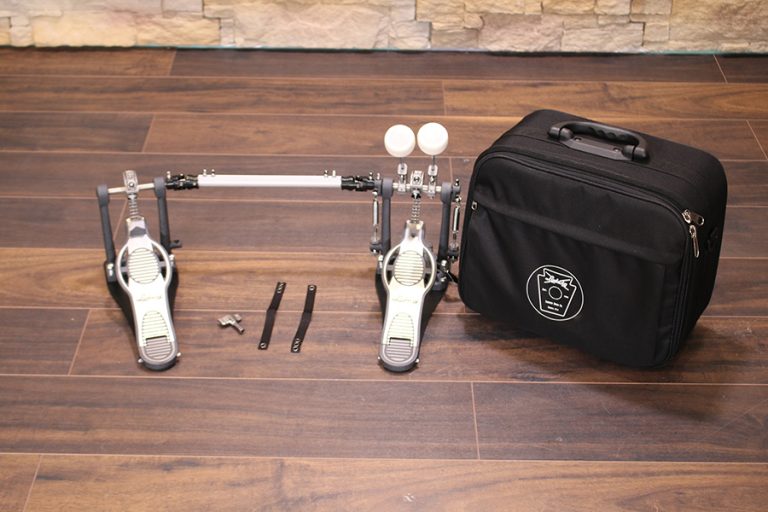
Ludwig Says…“Play with comfort, play with ease, and FLY on our new professional model double bass drum pedal. Designed as an extension of our Speed Flyer single pedal, this new model captures all of the performance features of the single into a new double format for all of your double kick needs. A simple 3-point adjustment format for quick setup and optimal performance settings.”
Find out our thoughts in the video above!!
Ludwig Speed Flyer Double Bass Drum Pedal (L205SF) – UK SRP: £452.00
For more completely impartial, HD video reviews, please subscribe to our YouTube Channel: www.youtube.com/drummersreview and click on the bell icon to be notified as soon as each new video is released. You can also follow us on our social media channels:
All of Drummer’s Review videos are recorded in a top quality studio with the finest equipment. To get the best from our reviews and really hear the instruments perform be sure to listen on good quality speakers or headphones!
As a professional drummer, Stereophonics sticksman Jamie Morrison has played stages big and small all over the globe, which is perfect as he has never wanted to do anything else!
Drummers Review’sAndy Hughes caught up with Jamie at his home in South London to discuss everything from his start as a musician, his attitude to production and his practice routines.
What are you doing right now Jamie?
The Stereophonics have just got back from Paris where we’ve been doing promotion for the new album. France loves the band, especially some of theolder material, so it’s been great to be out of the country for a few days after being at home for so long. It’s done us good to be back together again.
How did you start as a drummer?
I was like a lot of children, tapping on tables and so on, and I remember asking at school if there was a drum teacher and being told that there wasn’t. At secondary school, I remember walking past the music room and the drum teacher was teaching student. The teacher was demonstrating something, absolutely whaling away. I was absolutely transfixed: I was mesmerised, and that was it.
The teacher was a guy called Tom Revie and I recently got in touch with him and told him what a huge influence he had been on me as a musician. That was when I got that focus, it was something to put my energy into – it was all about music.
Did you feel it was something you had to do and that you wouldn’t be happy doing anything else?
I did, but I think that a lot of people feel like that about whatever it is that moves them. I think to be able to do it as a living as I can, is something else entirely, and I know that there is a huge amount of luck involved in that.
But when I say I was obsessed, I absolutely was, I practised for as many hours as I could growing up.
You have had masses of experience playing with different bands and artists, do you think that has informed your technique as a player?
That’s the key, absolutely. You can learn everything you are ever going to need, but there is absolutely no substitute for the experience of putting what you have learned into practice playing with other musicians.
When I was with my first band, I would take a gig anywhere, with anyone, literally anyone at all. I didn’t want to be paid; I just wanted the experience of playing in different settings. I knew the value of experience from very early on, and I put myself out there to get the chances to play.
My ambition, and my intention was to get another gig from every gig I ever played. I wanted a chance to play every day, that was what really mattered.
Who were your influences growing up?
I loved all the rock drummers. The Seventies were a time when drummers were celebrated, so I always enjoyed drummers from that period of music.
First of all, I got really into the technical aspects of playing drums, but then going around and watching other drummers, I got into players who were not necessarily technically gifted, or even correct in what they played, but they played it with such feel and emotion that I realised how important that aspect of playing drums is.
Then I got really heavily into songwriters, and I experienced the epiphany that loads of drummers know, and will tell you – it’s all about the song. The best songs to drum to are great stories, and I have always loved playing drums with great writers, that’s what excites me the most as a musician.
Do you have a favourite drumming style?
I love playing with my hands. When I first started playing drums, I used to play with my hands all the time, getting the feel of the drums and interacting with them physically. Then I went to brushes, and got the feel of the drum once removed, and it was a while before I actually started using sticks.
Individuality matters a lot, possibly more than anything else. Get your own style, your own feel, and you will always love paying your drums.
What are your practice routines?
I am someone who has to practice every day, but that doesn’t always mean sitting at my kit and playing. You should always be spending time thinking about how to push your techniques and skills and looking for new ways to do things.
I remember a teacher telling me that listening to an album is a much a vital aspect of practice as working out routines on your kit. If you develop your technique, the rest will fall into place, but as I said earlier, you should never pursue technical skill at the expense of feel and expression in your playing. I don’t like drummers who are all technical skill and no soul. I don’t mind drummers who have soul, but limited technique, but I always think to myself, think what you could do if you had the technical skills to match the feel of your playing. You need both, equally.
What’s your kit of choice?
I play Natal Drums and they are amazing because wherever I am in the world, they sort out drums for me. I saw George Frederick at a drum show in London, and he had a stand advertising his new drum camp The Freddie Gee Drum Academy. I went to the camp, and I followed George when he went to Ludwig, then to Premier, and then to Natal. I am a people person and I am very loyal to people who are loyal to me, and Natal have always been fabulous with their support. I have loads of kits from them I can’t possibly play all of them so every couple of years I donate a kit to a local school so that it can be played and give some pleasure to people.
Do you take lots of kit to sessions?
I usually take a selection of snares and bass drums with me to sessions. After a few bars of something, I can work out what I think the sound should be. To me, the drums always have a natural place to sit, you just need to work out where that place is.
Drums all have a natural sound, and for me, if the sound is not right, I’d rather change the drums than change the tunings. Guitarists always rock up with about ten guitars and a load of pedals, and everyone accept that as the way it naturally is. I think drummers should approach their instrument in the same way, for the same reason, let your instrument fit the sound you want.
On the song Running Round My Brain, you get a really full fat drum sound, is that down to tuning?
It’s partly tuning, but it’s also down to mic placing, I think drummers should think of it as part of their job to understand how microphones enhance their sound, including the right mic’s to use, and the right placings for them in the studio.
We used some overhead mic’s and I used dark cymbals, and I tuned the snare a little loose to give it that Levon Helm sound, that satisfying thud.
The song Right Place Right Time on the new album has a very ‘live’ feel to it, it’s very immediate. I told they guys when I recorded that drum track that it would be sampled for ever! That two-bar loop is going to be appearing everywhere.
I do remember that the studio we were in was a really big room, and I didn’t like the sound I was getting for that song, so I took my kick, snare and hi-hat on their own and set them up in a small vocal booth, and that got me the sound I wanted.
On the track You’re My Soul, the time signature is tricky, did it take you long to pick it up well enough to record it?
You say it’s tricky, but to me it feels very natural, so I didn’t have to work to get it down for the track. Kelly and I have an understanding of the way his rhythmic palette works. I listen to his words, and I can work out the rhythms that are going to work with the song he is developing.
My advice to drummers who are working out what to play for a track is, don’t overthink it, don’t break it down too much: go with the overall feel. And above all, don’t be afraid to ask to stop the session while you quickly try a couple of options to see what works best. You get better results by taking that bit of time, and it’s not unprofessional to take a few minutes to try something out.
As a producer yourself, how do you respond to producers in the studio?
Drumming is about collaboration. We are only really able to do what we do properly if we are in a room with other musicians. That means you have to be open to ideas, and to criticism, and that applies to me both as a producer and as a drummer. Whatever situation I am in, I am looking for the best idea, because at the end of the day the best idea is the one that works. On the way to the best idea, you are going to go through some other ideas that don’t work, and you discard them. Those can be my ideas, or other peoples’, but it doesn’t matter: it’s that end result that counts.
Watch Ringo in the Get Back documentary. He is always there, ready. He absolutely knows his place in the band, and his job is to be ready when an idea starts to form. The guys are tying things out to see what fits, what to move on with, what to leave out, and he is the always there, and ready to join in, and that’s the role of the drummer in a band. Ringo is there, he’s excited, and listening, with his antenna up, for something to happen.
If you are working with a band, don’t be on your phone, or chatting, or making tea, you should be tuned in and ready to pick up what’s going on and add your ideas, and contribute.
Stereophonics new album Oochya is out now – for more info visit: www.stereophonics.com
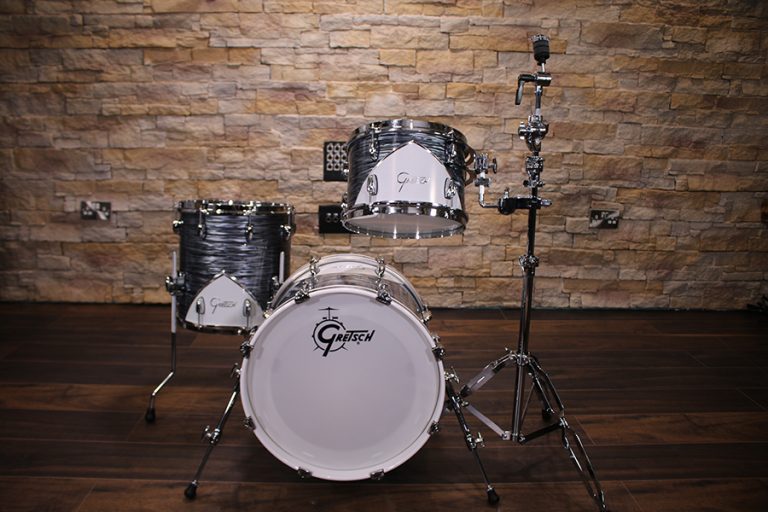
Here’s our review of a Gretsch Renown ’57 Bop Shell Pack, featuring…
18″ Bass drum,
12″ Rack tom,
14″ Floor tom,
7-ply all maple construction,
30˚ bearing edges throughout,
Silver Oyster Pearl Nitron finish (split chevron design),
Gretsch 302 double flanged hoops (toms)
Brilliant white (with matching inlay strip) wood hoops (bass drum),
Cigar shaped lugs throughout,
Remo heads fitted throughout – Clear Emperors / Gretsch-branded Permatone heads (toms), Powerstroke 3 batter & coated white resonant head (Bass drum),
Gretsch Silver Sealer interior.
Gretsch Says…“Today’s working drummers need a kit that can do it all—and do it well. Gretsch Renown is one of the most versatile drum sets ever made. Now, with one drum set, you can play with the sensitivity and touch to handle the smoothest grooves of the 1950s; the attack and projection required to drive the most powerful compositions of the 60s and 70s; and the clarity and vibrance needed to faithfully reproduce the clean studio sounds of the 80s, 90s and beyond.
Renown still features the classic 7-ply Gretsch formula maple shells, with 30-degree bearing edges and exclusive “Silver Sealer” interiors. But this Renown comes with a new twist with the addition of the Gretsch’s player-friendly “302” hoop—the same hoop used on Gretsch’s Brooklyn and Broadkaster series drums. Gretsch 302 hoops produce the desirable focused sound like that of a die cast hoop, but are lighter in weight and less rigid, allowing the drum to better “breath” and achieve maximum resonance. The 2016 Renown delivers the traditional Gretsch sound with an incredible open, harmonic tone that supplies the versatility needed to meet the demands of the hardest working drummers.”
Find out our thoughts in the video above!!
Gretsch Renown ’57 Bop Shell Pack – UK RRP: £1433.00
For more completely impartial, HD video reviews, please subscribe to our YouTube Channel: www.youtube.com/drummersreview and click on the bell icon to be notified as soon as each new video is released. You can also follow us on our social media channels:
All of Drummer’s Review videos are recorded in a top quality studio with the finest equipment. To get the best from our reviews and really hear the instruments perform be sure to listen on good quality speakers or headphones!



 What particularly attracted you to stave and segmented shells?
 Does your specialisation limit the potential customer base that other manufacturers who provide wider specs may enjoy?
 The pandemic has seen a seismic change for players, and suppliers of drums – how did it affect your business?






 RUTE-X RODS LIGHT GUAGE – UK RRP: £32.39

 NATE SMITH SIGNATURE STICKS – UK RRP: £14.99



 You have had masses of experience playing with different bands and artists, do you think that has informed your technique as a player?
 On the song Running Round My Brain, you get a really full fat drum sound, is that down to tuning?